Update 4/11/13
Wow, it's been three and a half years and I'm still getting comments on this! I thought the latest one was worth calling out because it seems that Bosch has, finally, recognized this as a design flaw and come up with a solution. Anonymous says:
Bosch has a permanent fix for this problem and will cover the cost of the part. They will only cover the cost if it is installed by one the Bosch Authorized Repair services. I was able to take the door in to the repair shop for a flat price of $50 for them to install the kit.
- Step 1: Call around to a Bosch authorized repair center till you find one who will do it for a flat fee.
- Step 2: Call Bosch and tell them you have been having the door problem since you bought it and want fixing kit that was designed to correct the manufacturing flaw. They will ask you to send a copy of your receipt for the stove. When they agree to cover the parts only tell them to send the order to the shop you have an agreement with for carry in service.
I used Jamie's fix years ago but it eventually failed again. The fix kit has reinforced steel plates tack welded to the inside of the liner where the hinges attach. You can buy kit and do it yourself $175-$211. Or Have Bosch cover the part and do an in home.
Good information. Personally - the fix I made back in '09 is still working fine for me. This solution seems fairly inconvenient and/or expensive (either you have to take your door to an authorized service center, and/or pay $175+!). But it's good to know there's at least a real fix available if this "hack" fails eventually.
Frankly, it's pretty crappy that Bosch won't just send you the hinge so you can install it yourself for free in 10 minutes. How generous of them to agree to pay to replace their defective part after five years of ignoring the problem.. but only if you pay them to install it!! So this doesn't really do anything to change my opinion of the lousy quality of their customer support. But still, good to have options.
In the nearly 4 years since I posted this problem, I've gotten over 80 comments, thousands of views, this page is the #1 google search result for
bosch range door and on the first page for lots of important variants such as
bosch range problems. You know how many times someone from Bosch has tried to contact me, commented here, or even addressed this issue in any public forum?
Zero.
It's 2009. Oh wait. Now, it's 2013.
Wake up. Your potential customers read this stuff. This is bad press. It could have been good press if you responded to it, ever.
Original Post 10/17/09
This is going to be one of those posts that most of you should skip, now, unless you happen to have a Bosch range on which the oven door doesn't close properly.

I have a Bosch HDI7282U 30" slide-in range which I bought new about two years ago. A few months ago the oven door stopped closing all the way, preventing a good seal. This caused a lot of problems, not the least of which is half the heat goes into the kitchen instead of staying in the range. Uneven cooking and verrrry long preheats was a consequence. While the range is probably still under warranty, my online research into this problem told me that I was far from alone. At least it's a common enough problem that others had discussed it in a few online forums. Unfortunately there was no good resolution that I could find, and those who had dealt with Bosch's service (even under warranty) did not get satisfaction. Can't say I'm excited to hear about that since I own three Bosch appliances. But I finally got around to trying to figure this out myself, and came up with a good solution that is simple and takes about 15 minutes.
Remove The Range Door
Start by taking off the range door. To do this, open the door all the way and flip the hinge-locks toward the door all the way. The two pictures below show the hinge in the normal position (left), and the locked position (right) needed to remove the door. Complete instructions are on
Page 48 of the manual. You can also download the whole manual
here -- I assure you it is a riveting read.
Once the hinge is in the locked position, you can basically just lift the door up an pull it out. The hinges have a little slot on the bottom and are cantilevered against a pin on the top. So you raise it up about 1/4" to clear the slot, and pull it straight out.
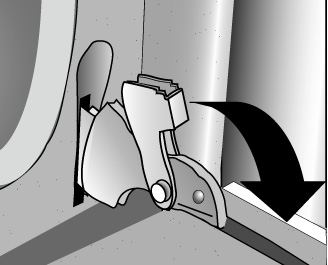
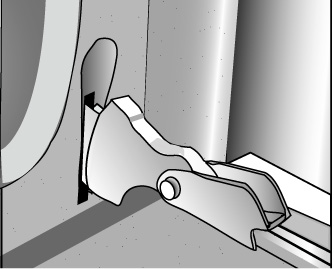 Below is a picture of my oven door with the hinge in the locked postion.
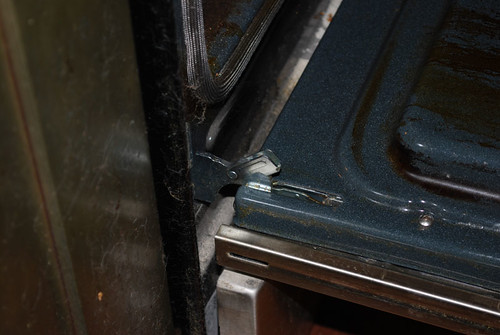 You must tilt the door to a 45 degree angle with the hinge locked before removing it. Do not try to close the door all the way with the hinge locked. From this position, just raise the door vertically about 1/4", then pull it horizontally awayfrom the oven.
 Remove the door hinges
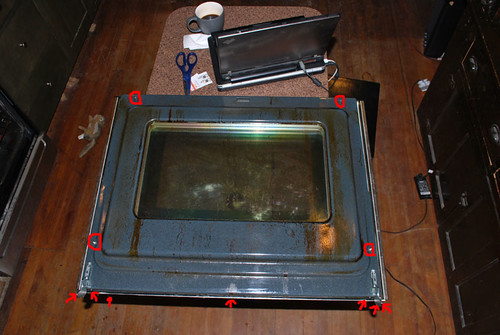
To do this you need two torx wrenches, a T10 and a T20. There are four screws holding the inside of the door to the outside, and three screws holding each hinge onto the door interior, for a total of 10 screws. Their approximate positions are circled in the photo of my door below. Yeah, it's pretty gross, and that's AFTER I cleaned it. Remove all the screws. When you take off the two at the top, be aware that the handle will no longer be attached to the door.
After all the screws are out, lift the door interior away from the exterior. The hinges are just loose now, they look like this:
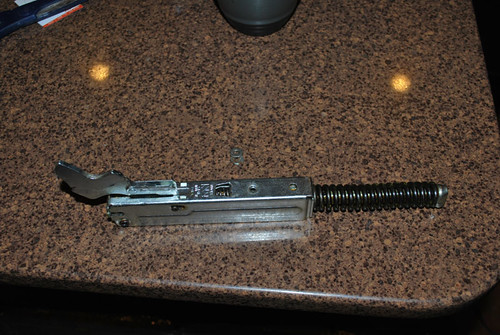
You're not going to do much now except put everything back together, with one minor adjustment. I'm not quite sure exactly what's causing the change in dynamics here resulting in the door not closing - either the hinge isn't quite right any more, or the pin inside the range itself that the hinge cantilevers against moved slightly. I saw no evidence of anything bent on the hinge itself so I am guessing it's the pin. Accessing this looks like a big hassle, even if it could be adjusted, so I went for a different solution.
To correct the problem, all you need to do is change the dynamics of the door so when the hinge is in it's "closed" position, the door once again is shut all the way. The simplest way to do this is to add some space between the back of the hinge and the door at the top of the hinge. In th picture above, you may be able to make out a couple little washers on the counter behind the hinge. Re-attach the hinge to the door interior, but put a couple washers between the large screw and the hinge itself. I used two washers on each side like the ones above, adding a little less than 1/8" of space. This results in a significantly bigger difference at the top of the door, and was just right to cause my door to close snugly.
Put It Back Together
After you've re-attached the hinges with your spacer, completely attach it using the two small screws for each. Put the door interior back over the door exterior, being sure to line everything up correctly. There are three tabs on the bottom that should go inside the interior, and make sure the handle is correctly positioned before tightening the two screws at the top.
After it's completely reassembled, simply put it back on the range, open it all the way, and return the hinge locks to the open postion. You're done.
3-year Thanksgiving update (11/20/2012): some early commenters wondered how long this fix would work. I am still working on the original fix and the door is still quite snug. Commenter #69 gives a very believable explanation as to the physics at work and why this happens in the first place or might fail again. Perhaps the pin can only bend so far in the way this is set up on the Bosch and in my situation it's reached that point. But I have not had any further trouble since I originally posted this fix.
On the other hand the thermostat is off by about 25 degrees now...

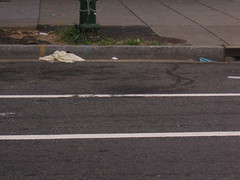 I wrote a while ago about my new hobby of picking up trash when I walk the dog in the morning. While not as glamorous as collecting cars or as interesting as beekeeping, it does have its moments. And it keeps the couple blocks around where I live looking pretty clean, which is nice.
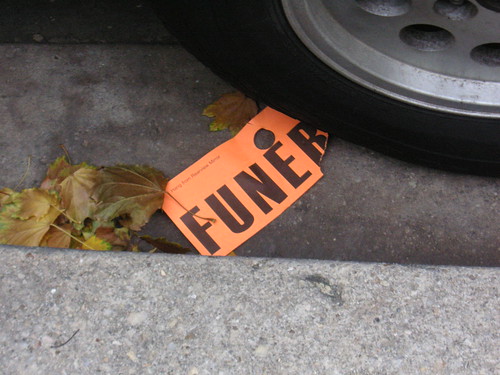 Several days ago, the normal tranquility of Columbia Heights was disturbed by paramedics on my street. By normal tranquility, I mean police helicopters, gunshots, and drunken yelling. This is not the first time I've seen such things, but as we watched a stretcher emerge from our neighors' home, we wondered if things were not more serious this time.
 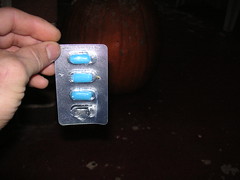 The final piece of trash will close this post on a lighter note. Outside "The Asylum," a DC outpatient mental health clinic near my home, I found this blister pack on the ground. Excited by the discovery of what I thought might be actual drugs, I peered purposefully at the pill pack. What would it be? Antibiotics? Antidepressants? A mystery drug which I would have to eat, identity unknown, like Alice and her mushrooms, in order to determine its true purpose? Would I take the blue bill??